
The Science
ANTIMICROBIAL RESISTANCE
One Specific Pathway in a Much Larger Problem.
Antimicrobial resistance is both a problem of pharmacology and a problem of infection control: how organisms develop resistance and how those organisms move from one body to another through air, surfaces, equipment, and hands.⁵
The supplied literature describes stethoscopes as one of the surfaces capable of moving organisms through a hospital and identifies resistant organisms documented on them that are also recognized as significant antimicrobial-resistance threats.⁵
No single device or protocol will address the healthcare-associated infection problem.
What matters is whether an intervention addresses the mechanism it claims to address, whether it does so reliably, and whether it takes its place alongside the other specific interventions through which the larger problem is addressed.⁵
OeUVre is doing one specific thing, on one specific pathway, that participates in that principle.⁵
Independent Laboratory Testing
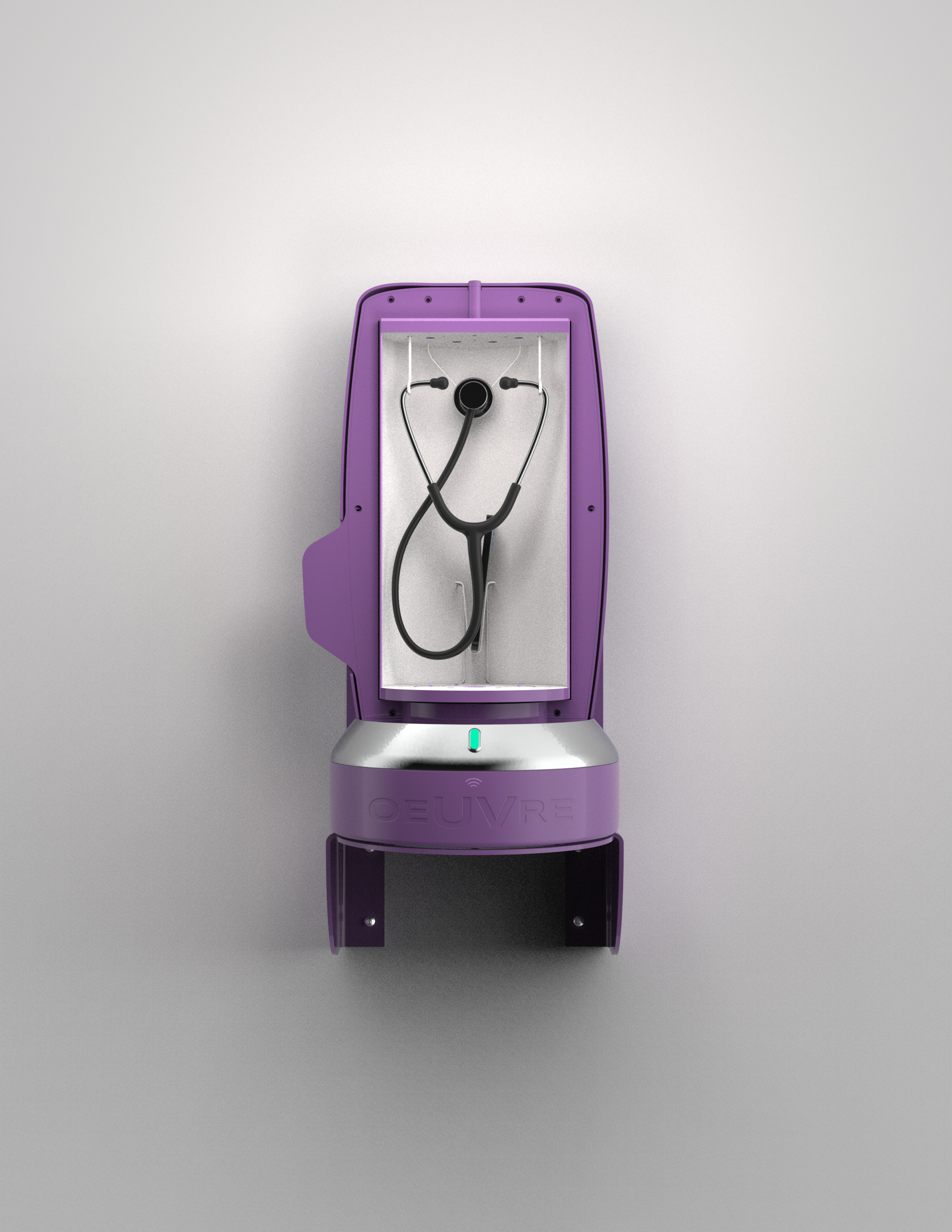
An independent ISO 17025 accredited laboratory studied the efficacy of an OeUVre prototype against drug-resistant bacterial pathogens in the presence of an organic load.³
The oeUVre Disinfection Device has been tested at Element Materials Technology, an independent product testing laboratory, against five bacterial species on the two items the device is designed to disinfect: the stethoscope and the cell phone. In a single one-minute cycle, the device achieved bacterial reductions of up to greater than 6.5 log₁₀ — more than 99.9999% of the bacteria eliminated — with the strongest and most consistent performance on the surfaces that touch the patient and the clinician. Results are reported as log₁₀ reductions: 3.0 means 99.9% of the bacteria were eliminated; 4.0 means 99.99%; 5.0 means 99.999%; 6.0 means 99.9999%.
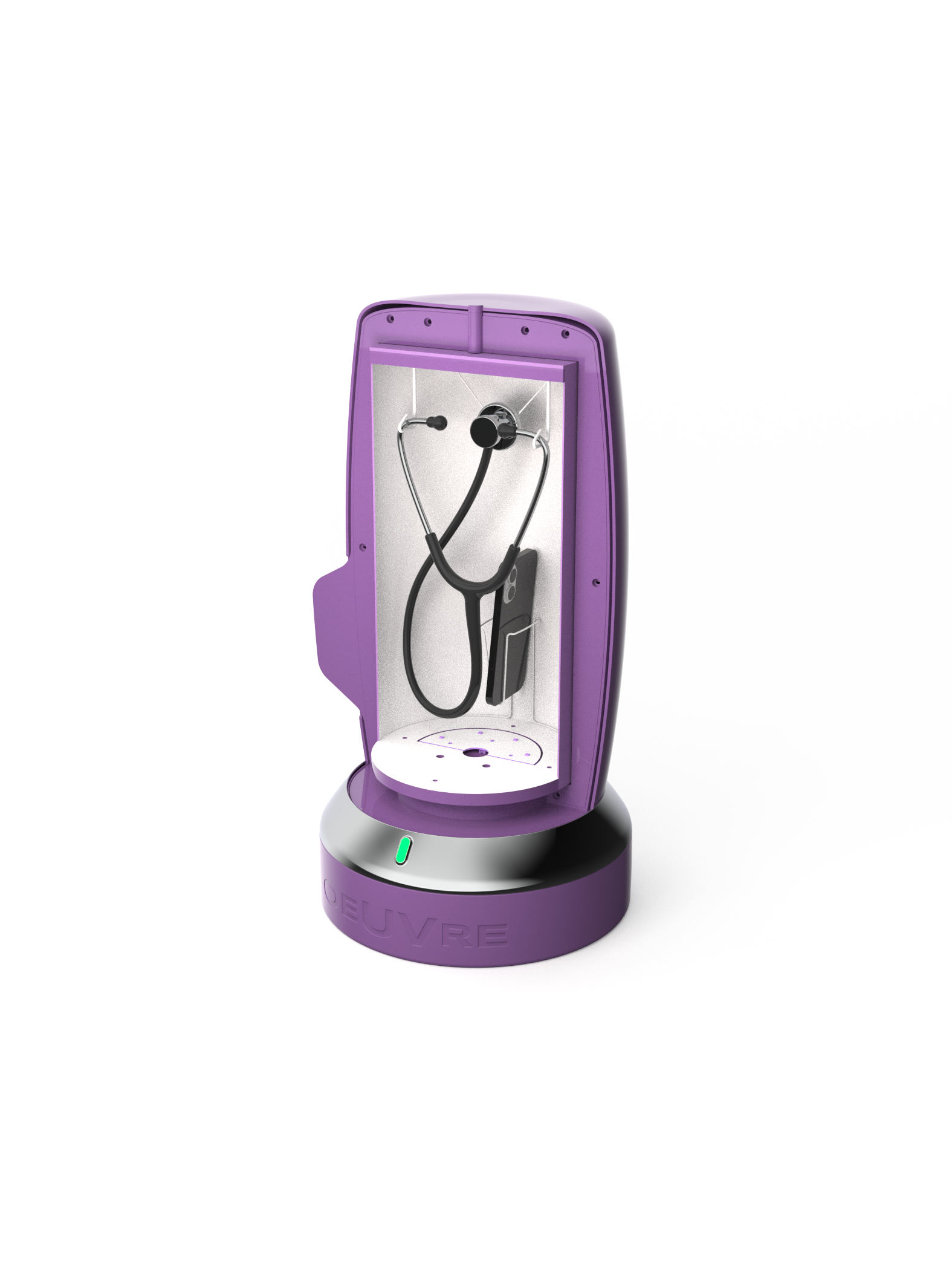
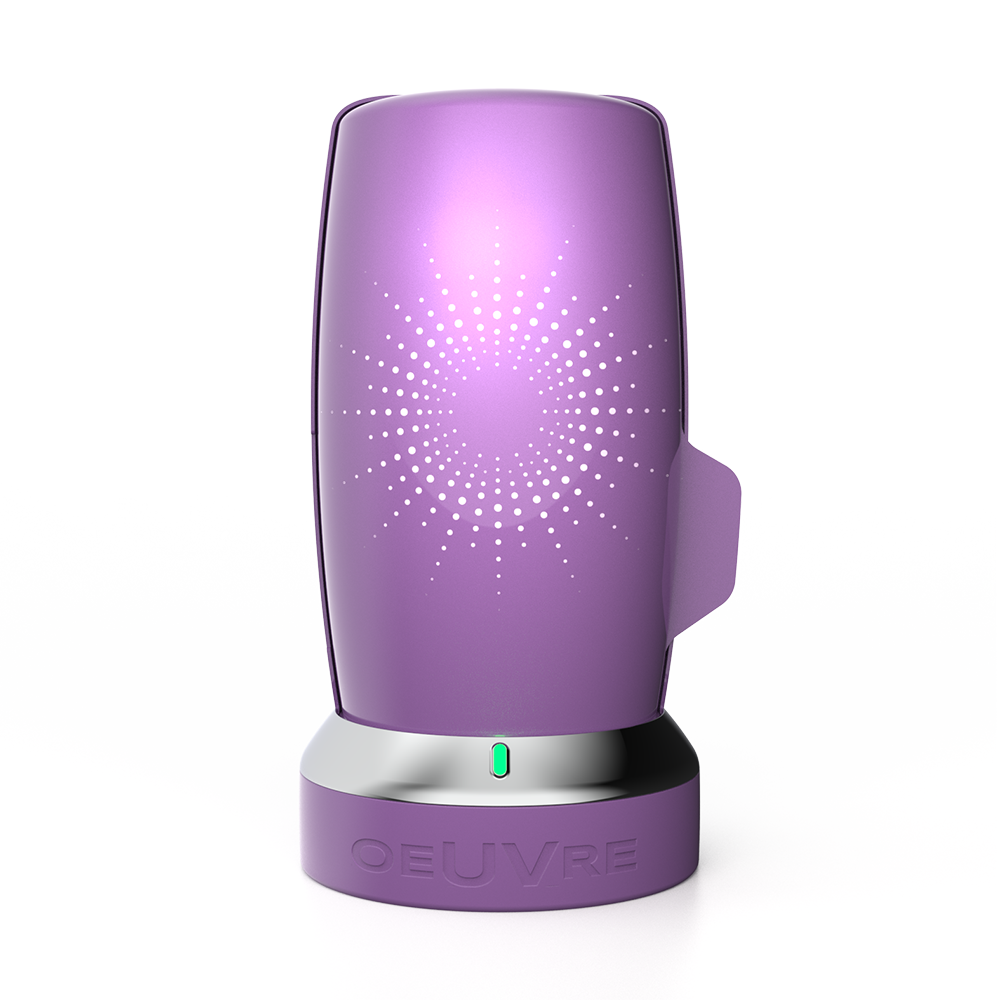
The device is a fully enclosed disinfection chamber. The ultraviolet source operates only with the door fully closed, and the chamber's specialized interior lining helps distribute the light throughout the chamber, exposing items on all sides during the cycle.
Stethoscope
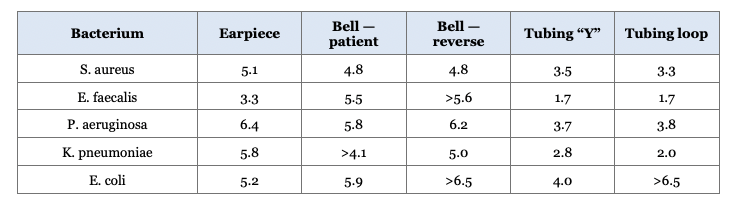
Testing was performed on a standard 3M Littmann Classic II Monitoring Stethoscope at five marked locations — the earpiece, both surfaces of the bell, and two points on the tubing — against a panel of five bacterial species.
On the patient- and clinician-contact surfaces — the earpiece and both faces of the bell — reductions ranged from 3.3 to greater than 6.5 log₁₀, with most results at or above 4.8 (99.998% or better), across every species tested. Results at the more remote tubing locations, which present the most complex geometry to the light, varied with that geometry.
Cell Phone
Testing was performed at nine locations across the front and back faces of a standard handset. The average reduction across the nine face locations was 3.8 log₁₀ — more than 99.98% of the bacteria eliminated — with individual locations ranging from 3.3 to 4.3, and three locations reaching 4.0 (99.99%) or better.
Tested again with a stethoscope in the chamber at the same time — both items disinfected together in one one-minute cycle — eight of the nine face locations achieved 4.0 log₁₀ (99.99%) or better, with a peak beyond 6.2, while the stethoscope simultaneously exceeded 5.3 log₁₀ on all its patient-contact surfaces.
References
Bacterial contamination of stethoscopes on the intensive care unit. Anaesthesia. 2009;64(6):620–624.
Whittington AM, Whitlow G, Hewson D, Thomas C, Brett SJ.
1
Guideline for Disinfection and Sterilization in Healthcare Facilities. 2008.
Rutala WA, Weber DJ. Healthcare Infection Control Practices Advisory Committee.
2
Includes device specifications and results from an independent laboratory study of an Oeuvre prototype against drug-resistant bacterial pathogens in the presence of an organic load.
OeUVre Literary Narrative, Revision 2, April 13, 2026.
3
On Resistance.
On Cellphones.
4
OeUVre supplied literature. Discusses cellphone contamination in medical facilities, reported organisms, contamination rates, and the expanding role of cellphones in clinical environments.
OeUVre supplied literature. Discusses antimicrobial resistance, infection control, stethoscope contamination, resistant organisms, and the role of specific infection-control interventions.